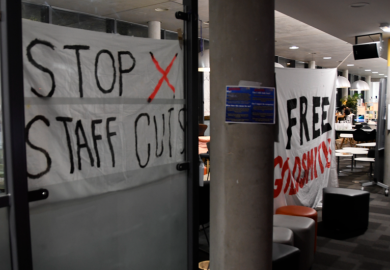
An academic union has called for all appointed positions on the Australian National University (ANU) council to be voided, following the emergence of figures suggesting that the institution’s financial crisis has been exaggerated.
The university’s preliminary 2025 accounts record an operating deficit of A$45 million (£24 million) – “approximately A$65 million better than budgeted” – according to the published minutes of an ANU council meeting.
The National Tertiary Education Union (NTEU) said ANU had also overstated its projected 2024 deficit by A$60 million. The predicted A$200 million shortfall that year had been used to justify the “Renew ANU” programme of savings, including an estimated 638 job cuts.
Renew ANU was suspended in September last year, a week after Genevieve Bell resigned from the post of vice-chancellor. By that stage, the university’s workforce had shrunk by the equivalent of 370 full-time staff over 12 months, according to recently published statistics.
Lachlan Clohesy, secretary of the NTEU’s Australian Capital Territory division, said the university’s governing body had presided over an aggregate A$125 million overestimate of the 2024 and 2025 deficits. “This is another nail in the coffin for ANU council, which supported and approved plans to cut hundreds of jobs based on flawed rationale and continued to support during implementation.
“There are serious questions about whether council members have exercised due diligence and appropriate oversight. These cuts were pursued with the steadfast support of chancellor Julie Bishop and appointed members of ANU council. They need to go.”
ANU said it “does not comment” on council discussions. “Financial stability remains a priority, and expenditure controls have helped stabilise the university’s position,” a spokesperson said.
“Despite recent challenges, the university’s academic performance remains strong. It leads the sector with the highest retention and graduation rates of students from disadvantaged and under-represented backgrounds, and is home to one of the strongest Indigenous student communities in the country. As Australia’s national university, our work attracts close public attention, and that is entirely appropriate.”
The university is “targeting a balanced budget by the end of 2026” and consulting widely to “shape” its next strategy and ensure that it is “well positioned for the future”, the spokesperson said.
The council minutes show that “savings targets” contributed to the improved bottom line, along with “lower than expected” research spending and “unbudgeted” philanthropic revenue. “The budget is in a much better position than it was,” they note. “The university has demonstrated that it can control spend.”
But “soft enrolments” so far this year pose a “risk” to revenue, and more capital and research spending will be needed in future years, they add.
The Australian National Audit Office is due to report next month on the university’s financial management of Renew ANU. According to draft findings reported by ABC TV’s Four Corners programme, the ANU council “approved the proposed cuts without clear evidence that they were needed, urgent, achievable or likely to have their intended impact”.
“While ANU revenue was not keeping up with costs, it faced no immediate financial crisis, and that undermines the whole rationale behind those deep cuts,” Four Corners reported.
The university regulator Teqsa has instructed ANU to suspend recruitment activities for a substantive vice-chancellor or a replacement for Bishop, whose term ends this year, pending the release of a report commissioned from former public service commissioner Lynelle Briggs.
Teqsa is considering a “complete spill” of the governing council after it receives the Briggs report late this month, according to the Saturday Paper.
Tender notices published by Teqsa last month may offer insights into its thinking. One lists an A$80,000 contract for an organisational development consultant to provide “change management services”. A separate A$60,500 contract is for a company that evaluates board governance to undertake “design, facilitation and consolidation of a strategic planning process”.
Register to continue
Why register?
- Registration is free and only takes a moment
- Once registered, you can read 3 articles a month
- Sign up for our newsletter
Subscribe
Or subscribe for unlimited access to:
- Unlimited access to news, views, insights & reviews
- Digital editions
- Digital access to THE’s university and college rankings analysis
Already registered or a current subscriber?